Check out my new threads! This amazing, one of a kind fugu, or smock, and hat was gifted to me by the Bethel Methodist Church, Ghana, at our combined World Communion Sunday service. Reverend David Atoko leaned over to me during the service, saying he wanted to make a “special presentation” near the end of worship. Pastor David brought it back from Ghana, where he purchased it for me last month. It is very heavy- heavier than my clergy robe. I even wore it for the special service for the Albert Academy in Sierra Leone that afternoon. I received many compliments! I usually do not like surprises, but this one I will always remember! Thank you, Bethel Church!
Some time ago, the Ghanaians introduced me to the tradition of naming someone after their birthday- the day of the week. Since I am still waiting for Spring Valley’s beloved Sierra Leonean community to give me my promised African name (three years and counting), I took to being called Kwabena, since a quick internet search revealed that February 2, 1971 was a Tuesday. After seeing me in my new fugu, Sister Esther of Bethel said my new name is Papa Kwabena, or Father Tuesday!
World Communion Sunday is a terrific observance, highlighting the diversity of the Body of Christ, and celebrating the world-wide nature of Christ’s mission: to the ends of the earth (Acts 1:8). The combined service in Wesley Chapel was probably 60% or more immigrants to the USA. Recently Maeson Bryant, David Smith and I attended a faith partners breakfast with RISD Superintendent Tabitha Branum. She celebrated many of the achievements of Richardson ISD in the past year:
2026 score increased from 79.4 to 83
31 schools earned an A or B
5th best overall school district in Dallas County
5th highest average SAT score in Texas
And my favorite, and most relevant to this column: 4th most diverse school district in Texas
Top languages spoken in RISD after English: Spanish, Pashto, Amharic, Arabic, Farsi
I see this diversity every Tuesday morning at the Mobile Food Pantry on the RISD Academy campus. I see it again in the same place one Friday a month, serving as a mentor for Academy 4. Superintendent Branum listed up that campus as in desperate need of community support, and we will be meeting with key leaders there soon to discern how Spring Valley can serve there.
In the meantime, I want to say a word of appreciation to our immigrant community here at Spring Valley. I recently presided at the wedding of Janice Sechyi, daughter of Johannes and Brenda, who was raised here. The wedding was a joy occasion. Christy was even invited to participate in the African tradition of making a dress in a special pattern chosen by the wedding couple for the occasion. Check us out- not only her dress, but my matching pocket square and tie! After seeing us at the reception, one of the guests said, “Now you are African.” And that was before receiving the fugu from Ghana!
Anyway, Spring Valley’s immigrant families have been a valuable part of our church’s DNA for more than thirty years. Thank you for your dedication, your joy, and your perseverance!
Ho, everyone who thirsts, come to the waters; and you that have no money, come, buy and eat! Come, buy wine and milk without money and without price. Why do you spend your money for that which is not bread, and your labour for that which does not satisfy? Listen carefully to me, and eat what is good, and delight yourselves in rich food. Incline your ear, and come to me; listen, so that you may live. I will make with you an everlasting covenant, my steadfast, sure love for David. See, I made him a witness to the peoples, a leader and commander for the peoples. See, you shall call nations that you do not know, and nations that do not know you shall run to you, because of the Lord your God, the Holy One of Israel, for he has glorified you.
Seek the Lord while he may be found, call upon him while he is near; let the wicked forsake their way, and the unrighteous their thoughts; let them return to the Lord, that he may have mercy on them, and to our God, for he will abundantly pardon. For my thoughts are not your thoughts, nor are your ways my ways, says the Lord. For as the heavens are higher than the earth, so are my ways higher than your ways and my thoughts than your thoughts.
For as the rain and the snow come down from heaven, and do not return there until they have watered the earth, making it bring forth and sprout, giving seed to the sower and bread to the eater, so shall my word be that goes out from my mouth; it shall not return to me empty, but it shall accomplish that which I purpose, and succeed in the thing for which I sent it.
For you shall go out in joy, and be led back in peace; the mountains and the hills before you shall burst into song, and all the trees of the field shall clap their hands. Instead of the thorn shall come up the cypress; instead of the brier shall come up the myrtle; and it shall be to the Lord for a memorial, for an everlasting sign that shall not be cut off.
Several years ago I watched the excellent documentary Summer of Soul. The film tells the story of “Black Woodstock,” during the summer of 1969, when for six consecutive Sundays at a park in Harlem, Black musicians from Stevie Wonder to Gladys Knight to Mahalia Jackson performed. It was the first time I heard Nina Simone perform- I immediately sought out other documentaries about her! The music was terrific, the fashion on display was on point, but what I am remembering most specifically today were interviews with folks in the crowds. One Sunday, July 20, a white reporter walked among the crowds, asking the overwhelmingly Black attendees what they thought about the lunar landing that happened that day. After all, the whole world was buzzing about it. “What do you think?” the guy asked several people. “We don’t care about that.” “You’re spending all that time and money up there, while people in our own neighborhoods are going hungry, in need of work, suffering from violence. We have our own issues to think about.” The reporter was flabbergasted, so surprised to hear such a response. We had accomplished such a terrific thing! But when members of the community are suffering, what’s there to celebrate?
This weekend is the anniversary of the signing of the Declaration of Independence, signed 250 years and one day ago: “We hold these truths to be self-evident, that all men are created equal, that they are endowed by their Creator with certain unalienable Rights, that among these are Life, Liberty and the pursuit of Happiness.” When asked how they are participating, Americans had various responses: from last Sunday’s Dallas Morning News:
Why is this change in attitude happening? One thought I had in the weeks I have spent writing this message is this: too often our rhetoric about the USA doesn’t match the reality for many Americans. “This is the greatest country in the world.” “Anyone can achieve anything here.” George Washington wrote a letter written to the members of the nation’s oldest synagogue, Touro Synagogue in Newport, Rhode Island. “The Government of the United States … gives to bigotry no sanction, to persecution no assistance,” he wrote. “May the children of the Stock of Abraham, who dwell in this land, continue to merit and enjoy the good will of the other inhabitants, while everyone shall sit in safety under his own vine and fig tree, and there shall be none to make him afraid.”
But many people do feel afraid. Immigrants, people of color, gay, lesbian and transgender neighbors are seeing their rights threatened. Christian Nationalism would impose a certain worldview on others- claiming their understanding of God is correct. In a free society, persons of faith shouldn’t need the government to protect their faith versus the faith of others. There has never been a time in our history- going back even further than 250 years- where everyone worshiped the same, believed the same, had the same understanding of patriotism or love of country. If we have freedom of religion, it has to be for everyone, and must also include freedom from religion.
This week the Supreme Court handed down decisions that will have an immediate impact on large numbers of immigrants who came here seeking asylum or protection. The United Methodist Social Principles affirm that every migrant, refugee and asylum seeker bears the image of God and possesses inherent dignity and worth, regardless of country of origin or legal status. The Rev. Kendal L. McBroom, Director of Civil and Human Rights at the United Methodist Church’s General Board of Church and Society, said “…these decisions weaken our nation’s moral witness and undermine the longstanding commitment to offer refuge to those seeking safety. We call upon our elected leaders to pursue policies that reflect justice, mercy and the sacred worth of every human being, ensuring that our immigration system embodies both the rule of law and the moral courage to protect those in need.”
Ironically, the Constitution did not guarantee those rights the Declaration of Independence aspired to- it has been amended over and over, and many of those amendments, especially ones related to civil rights, have come under threat in recent years- including just this week. We are also seeing limits on democracy- voting rights are being severely limited; congressional redistricting adversely impacts communities of color- so fewer communities find themselves represented where decisions are made. When people feel disenfranchised, when people believe the country only works for the most powerful, and the disparity increases each year, you can see why people have different feelings about the 4th of July. For many Black Americans, freedom is celebrated on Juneteenth, when enslaved people in Texas in 1865 first learned of the Emancipation Proclamation issued two years earlier, not July 4, 1776- because not all Americans were free then.
So all of this is to say: there are legitimate questions about whether we are living up to our ideals- and who we are leaving out or behind. Which brings me to a sign I saw recently driving through Celina, Texas: “Prevent patriotic panic.” I had to double take when I drove past it: “Prevent patriotic panic.” It was a veterinary clinic- selling medication to keep animals calm during fireworks. But to prevent patriotic panic here, let’s go back to the Isaiah text and hear its wisdom.
Ho, everyone who thirsts, come to the waters; and you that have no money, come, buy and eat! Come, buy wine and milk without money and without price. Why do you spend your money for that which is not bread, and your labour for that which does not satisfy? Listen carefully to me, and eat what is good, and delight yourselves in rich food. Incline your ear, and come to me; listen, so that you may live.
These words were written to an exiled community, who had lost the Promised Land and were displaced from their homes. They struggled to maintain their unique identity in a culture vastly different from their own. But God invites them to something better. They do not have to buy in to the economy to find fulfillment- everyone who is hungry or thirsty is invited to the Lord’s table. Nothing offered there can be bought; God’s grace guides the people and provides for them.
Seek the Lord while he may be found, call upon him while he is near; let the wicked forsake their way, and the unrighteous their thoughts; let them return to the Lord, that he may have mercy on them, and to our God, for he will abundantly pardon.
There is room at the table for our brokenness. There is room there for our imperfections. We are invited to confess our sins, with humility to recognize God’s sovereignty and majesty, and receive divine forgiveness. Return to God, for [God] will abundantly pardon.
For as the rain and the snow come down from heaven, and do not return there until they have watered the earth, making it bring forth and sprout, giving seed to the sower and bread to the eater, so shall my word be that goes out from my mouth; it shall not return to me empty, but it shall accomplish that which I purpose, and succeed in the thing for which I sent it.
God’s word comes to us as rain to the barren desert. The moisture does not return to the heavens until it has served its natural purpose- allowing the land to produce abundantly. God’s love, forgiveness, mercy and compassion are offered to us, and they do not return until they have accomplished their purpose.
For you shall go out in joy, and be led back in peace; the mountains and the hills before you shall burst into song, and all the trees of the field shall clap their hands. Instead of the thorn shall come up the cypress; instead of the brier shall come up the myrtle; and it shall be to the Lord for a memorial, for an everlasting sign that shall not be cut off.
All creation celebrates with joy as the people once displaced are returned to the God who renews the divine covenant- a new birth of freedom, to use President Lincoln’s words from the Gettysburg Address. The hymns we sang this morning are aspirational. They sing to a promise of a nation, where true freedom is offered to all: God mend thine every flaw, confirm thy soul in self control, thy liberty in law. Long may our land be bright with freedom’s holy light. And The Battle Hymn of the Republic, written in 1861- not 1865- puts the Civil War in a theological light: as [Christ] died to make men holy, let us die to make men free- our God is marching on.
Bishop David Wilson serves in the Great Plains Conference. He is the first Native American to be elected to episcopal office in The United Methodist Church. He is an enrolled member of the Choctaw Nation who also has Cherokee lineage. He recently shared his reflections on the contributions of native peoples in the creation of the United States:
The Library of Congress reports that the Senate recognized the influence of the (Iroquois) Confederacy on the construction of the Constitution, noting: ‘The original framers of the Constitution, including most notably George Washington and Benjamin Franklin, are known to have greatly admired the concepts, principles and governmental practices of the Six Nations of the Iroquois Confederacy… the confederation of the original Thirteen Colonies into one republic was explicitly modeled upon the Iroquois Confederacy as were many of the democratic principles which were incorporated into the Constitution itself.’
Interestingly, it was not until June 2, 1924, that Indigenous persons in this country were recognized as citizens of the United States. President Calvin Coolidge singed the Indian Citizenship Act, also known as the Snyder Act, into law. He observed the way that many tribal members enlisted in the military in World War I, before they were even U.S. citizens. The perspective of Indigenous persons is often overlooked. Despite the history and colonization of Indigenous persons, this is still our country. Even today, tribal people in this country serve in the military, per capita, at the highest rate of any group in this country. Soldiers come home to celebrations and recognition throughout. Indigenous veterans are highly respected.
Onondaga Faith keeper Oren Lyons said: ‘What Indians are about, I think, first of all is community. They’re about mutual support, they’re about sharing. They’re about understanding what’s common land, common air, common water, common and for all. They’re about freedom.’
I found this litany, written in 2026 by Rev. Tony Serbousek, Lakota, pastor of Concordia (Kansas.) First and Trinity UMCs.
A Litany for the 250th Anniversary of American Independence Remembering the First Peoples of this nation.
Leader: Creator of all nations and peoples, before there was a United
States, this land was home to Indigenous people who had their own
languages, traditions, and communities. However, the atrocities of
genocide through colonization erased these traditions, language and
communities.
People: We give thanks for the First Peoples of this land and for their
courage, bravery and enduring presence among us that made sure their
history did not get erased.
Leader: For the wisdom of elders, the stewardship of all that Creator
entrusted to their care, for the courage of leaders, the faithfulness of
communities, and the gifts of Native cultures,
People: We give thanks, O Creator.
Leader: For the beauty of the prairies, forests, rivers, mountains, and
deserts entrusted to our care,
People: We give thanks, O God.
Leader: On this 250th anniversary of American independence, we
remember that freedom has not been experienced equally by all.
People: Teach us to not avoid the disturbing truth and to remember and tell
these stories with humility and grace.
Leader: We remember broken treaties, lands taken, families separated,
languages silenced, and sacred traditions suppressed. For the hundreds of
children who were abused sexually and physically and for those children
who never returned home.
People: Lord, have mercy.
Leader: We remember Native communities that endured hardship and
forced from their homelands yet preserved their identity, dignity, and hope.
People: Strengthen us to honor their resilience.
Leader: For Native veterans who have served this nation, for tribal leaders
who guide their people, and for all who work for justice and reconciliation.
People: We pray that you will lead them with wisdom and peace.
Leader: As we celebrate the freedoms we enjoy,
People: May we also seek freedom from prejudice, ignorance, and
indifference.
Leader: As we honor the past, help us to not forget it.
People: May we learn from it and not repeat its wounds.
Leader: As we look to the future, walk with us Great Mystery,
People: May our Indigenous nations be brought out of the poverty that
pervades so many Native communities today.
Leader: May the diverse peoples of this nation walk together in mutual respect.
People: Teach us to see each of us as all of our relation that respects each
other and the land we live on.
Leader: Creator God, whose image is reflected in every people and nation,
People: Unite us in equality, justice, truth, and peace.
Leader: May this 250th anniversary renew our commitment to liberty and
dignity for all.
People: And may the next seven generations inherit a nation marked by
reconciliation, compassion, and hope.
Leader: We pray in gratitude for this land, its Indigenous people, and all
You’ve probably heard of the tradition of cardinals representing loved ones after they have departed. I had heard of it before 2019, and was at best, unsure. But then my grandmother died in 2019, and I started seeing cardinals more frequently- or maybe they were as consistent as before, I just failed to notice them. So when Emily Blunt‘s character in Disclosure Dayis visited by a cardinal in her home in the first ten minutes of the movie, I thought: here we go (you’ll notice the silhouette of a cardinal on her face on the movie poster- a detail I only noticed after my second viewing of the film).
Turns out Disclosure Day isn’t really about grief- the cardinal’s visit represents something else- it is about innate human curiosity and wonder. When we allow ourselves to be led by curiosity and wonder, rather than fear and a need for control, we take a step further down the road of evolution. We become more of what we were meant to be.
Disclosure Day is another of Steven Spielberg‘s movies dealing with “close encounters” between humans and visitors from outer space- but it is not about aliens, and it’s not a horror or science fiction movie, either. I don’t watch trailers for movies I am interested in- for months I have run out of auditoriums when the first hint of next month’s Odyssey is previewed- but when trailers for DD aired in recent months I remained in the auditorium, sometimes with my eyes closed and not paying attention to dialogue. I knew it had something to do with aliens, and I remembered that sound Emily Blunt makes when she stands in front of the weather map.
That was all I knew.
Spoilers ahead for Disclosure Day. If you want to stop reading because you haven’t seen it yet, good for you- I’ll say it is a 9+/10. I have seen three movies twice this summer so far: DD, Obsession (11/10), and The Mandalorian and Grogu (7/10)- I only saw that one twice because the second screening was a different digital format and I was curious how it would be different; it wasn’t, and I feel asleep more than once.
Last warning for spoilers..
Emily Blunt is giving the weather report on a local news segment from Kansas City. She begins speaking in a foreign tongue, but not the way she just spoke Korean to an awaiting guest for preparing for the next news segment or at her loft when she spoke Russian to her boyfriend. The Russian part happens immediately following the visit of the cardinal I mentioned earlier. Not only can she speak and understand other languages, she can read the minds of people by looking in to their eyes- a police officer, colleagues at work, her boyfriend. While the rest of the world is fretting about the possibility of WWIII breaking out, she is panicking because she doesn’t understand what is happening to her. She knows she must leave town immediately and meet up with Josh O’Connor’s character. That guy also is experiencing previously unknown knowledge- his for years, hers for minutes; hers language and mind reading, his math, the “language of the universe.”
The new knowledge was given to them both by… you could probably guess.
Josh’s knowledge of maths led him to be hired by a tech company in the business of cyber security. We learn this company obtained alien technology first in 1947 at Roswell, New Mexico. Over the decades the company and the government kept this knowledge and technology secret from the world’s population. Josh O’Connor and Emily Blunt are the centerpieces of a plan masterminded by the brilliant Colman Domingo to disclose the information about the coverup and the existence of “other worldly species” visits for the last seventy years. Of course the company wants to keep this secret- out of fear of their own profits, but also humanity would tear itself apart given this new knowledge, when things are already terrible enough in the world.
The movie also has some interesting conversations around theology: if people learned of the existence of alien/superior beings, would they stop believing in God? Does Christian faith allow for the existence of life elsewhere? A nun, when questioned by Eve Hewson‘s character about the potential impact of this new knowledge on faith, says God “gave humanity dominion over this world” (“…over all the earth…” says the Bible [Genesis 1:26]). Earlier in the movie, we learn from Eve that she lived in a convent for three years, leaving not because she lost her faith in God, but in the Church. During this important phone conversation, the nun says, “You never lost your faith in God; you lost your faith in people.”
Disclosure Day wants us to reinvest in people, in community. At one point there is a debate between Colman Domingo and Colin Ferth‘s character- he heads up the company trying to keep the alien knowledge and tech proprietary. Colman has a great line about empathy- I meant to write it down at my second screening but I was too caught up in the moment and forgot- and I can’t find it online. Colin Ferth tries to dismiss it as “bleeding heart.” Emily Blunt is able to see and know people at their deepest level, which is a blessing and a curse to her. At one point she turns away from people, not wanting to become their religion. She also must confront her own past, which brings us back to the cardinals- a mobile in her childhood bedroom- a memory she has tried to hide for her adult life.
Like Close Encounters of the ThirdKindand ET a few years later, movies set within the context of humans and aliens, Disclosure Day is really about connections with one another. The deeper knowledge being offered by the interplanetary guests is the power of empathy. Seeing people, knowing their stories, embracing each other with vulnerability. Literally the film ends with one word: “Listen.”
Fear of the unknown, fears of lost power or wealth, keep us from becoming more. Speaking to his new disciples about the challenges they will face bringing the Gospel to new people, Jesus says, “So have no fear of them… what I say to you in the dark, say to them in the light, and what you hear whispered, proclaim from the rooftops. Are not two sparrows sold for a penny? Don’t be afraid; you are of more value than many sparrows” (Matthew 10:26-27, 29, 31).
Or cardinals?
Related: my definitive ranking of the top 10 Spielberg movies that I have seen; no, I never saw Jaws.
“The Church of South India (CSI) is one of the largest Christian denominations in India and maintains congregations throughout the United States and Canada. The CSI North America Conference is among the largest gatherings of CSI congregations across the continent, bringing together clergy, church leaders, youth, families, and professionals for worship, fellowship, leadership development, and community engagement.
Hosted by Love of Christ CSI Church, Dallas, this conference reflects our commitment to fostering Christian unity, nurturing future generations in faith, and serving our communities with the love of Christ. Delegates from across North America will gather alongside distinguished church leaders from India and the diaspora, including the Moderator of the Church of South India, the Deputy Moderator, CSI Bishops, clergy, and lay leaders.
As a shepherd and spiritual leader within the Christian community, your faithful ministry, commitment to proclaiming the Gospel, strengthening the Church, and serving God’s people continue to inspire and bless many. Recognizing our shared connection and your heart for the growth and mission of the Love of Christ CSI Church, it would be our great honor and privilege to welcome you as a distinguished guest at the inaugural session.
We would also be grateful if you could provide a Goodwill Message (250–500 words) for publication in our Conference Souvenir. The souvenir will be distributed to all registered participants and shared with CSI congregations throughout North America, allowing your message to reach a broad audience of church leaders, families, and community members.”
Here is what I wrote (499 words):
Dear Friends attending the CSI North America Conference,
“Grace to you and peace from God our Father and the Lord Jesus Christ” – Ephesians 1:2.
I was appointed as the Senior Pastor of Spring Valley United Methodist Church in Dallas in July 2023. Like many churches, Spring Valley had experienced years of decline and an aging congregation. Many longed for a return of younger families and more children and students. Nearly three years later, we were approached by the Love of Christ, Church of South India, seeking a new location for worship. They began meeting on our campus on the first of February, 2026, settling in what was the original sanctuary of the church for worship. The new congregation also claimed several Sunday school classes for children, youth and adults. At almost the exact same time, another younger congregation, Bethel Methodist of Ghana, began meeting on our campus. The prayers of the Spring Valley congregation were answered, though perhaps not exactly as they had imagined. But isn’t that how the Holy Spirit works at times?
I will always remember The Season of Lent, 2026. Just a few weeks after they began worshiping here, LOCCSI and Bethel Methodist joined Spring Valley United Methodist Church for a combined Ash Wednesday service. At the beginning of Holy Week, Palm Sunday, the three congregations processed through the neighborhood from a nearby park to the church, singing songs and waving palm branches. We worshipped together again on Good Friday- and following the service LOCCSI members hosted dinner for the three congregations.
I am reminded of the invitation Peter received to journey from Joppa to Caesarea from Cornelius. Seeing the Gentiles’ readiness to receive the Gospel, the apostle proclaims, “I truly understand that God shows no partiality, but in every people anyone who fears him and practices righteousness is acceptable to him” (Acts 10:34-35). The worship and fellowship we are experiencing through the congregations meeting at Spring Valley are a witness to the neighborhood and broader community. The joy, fellowship, and unity I have seen shared between the three congregations is a vision of God’s dream- people speaking with different accents, styles of dress, and countries of origin- yet all made in the divine image celebrating their diversity, uniqueness and giftedness.
I am convinced that God’s vision of diversity, inclusion and joy being witnessed at Spring Valley is not limited to this small corner of Dallas County. As the 35th CSI Family & Youth Conference begins, my prayer for this occasion is that those participating will see a glimpse of this reality as well. When people of different backgrounds and traditions come together at the invitation of Christ, people experience faith on a deeper level. May more and more people be inspired by our love and support for each other- that the world may know the love and grace of God, revealed in our Lord Jesus Christ, under the guidance of the Holy Spirit.
Rev Dr Frank Drenner, Senior Pastor, Spring Valley United Methodist Church
I have bought in to the World Cup this year as never before- literally I am wearing a Word Cup t-shirt as I write this, and tomorrow I will wear a USA soccer jersey ahead of their game against Australia! I have watched nearly every match, not all start to finish, since the tournament began. And I have taken to watching them in Spanish, even though I do not speak the language. Why? Three reasons:
As I said in the first “The Crowd Goes Wild!” series sermon a couple of weeks ago: I don’t really get soccer, beyond kicking the ball in to the net; so since I don’t understand anyway, why not?
Joy. Those announcers get in to it! Every GGGGOOOOOOAAAAALLLLLLLL, regardless of who scores, fires me up!
Telemundo doesn’t play along on the silly “hydration breaks,” new this year, really just an excuse to break away for a commercial break. The feed stays in the arena, checking out the fans and players.
But aside from the matches themselves, it’s the vision of a unified humanity that is so compelling for me. The fans of both teams are singing their songs and enjoying one another. Fans of other teams are in the stands as well- just there for the action and the spectacle. Videos of travelers coming to Canada, Mexico or the USA, trying out new foods and experiences- it’s heartwarming and fun, and calls us to do more to bring people together rather than divide.
As United Methodists, we understand our faith to be more than the individualized Christianity we experience from many churches. We emphasize the connection between social and personal holiness. We understand faith as a vehicle to bring into reality the world God envisions for humanity. This Friday marks the celebration of Juneteenth, a day to commemorate freedom and justice. If you are unfamiliar with this observance, now a national holiday, here is a summary from umc.org:
“By the time Union soldiers rode into Galveston, Texas, to announce the end of slavery, 2½ years had passed since the signing of the Emancipation Proclamation. The message of freedom had failed to reach a quarter of a million enslaved Black people. That is, until June 19,1865, the date that marked the end of government-sanctioned slavery in America, and that would become known as Juneteenth. Through the years, Juneteenth has been commemorated, primarily by Black Americans, with prayer events, families gathered around large meals and parades and festivals. In 2021, Juneteenth became a federal holiday in the United States, observing the date when news of emancipation was delivered in Galveston.
But in the words of Opal Lee, a Black woman from Fort Worth, Texas who is largely responsible for the national holiday becoming a reality, ‘None of us are free until we’re all free, and we aren’t free yet.’
The struggle for equality and justice—true freedom—continues. Inequity persists. As United Methodists, we vow to accept the freedom and power God gives us to resist evil, injustice and oppression. There is still much work for us to do. As we seek to make disciples of Jesus Christ for the transformation of the world, we do so in this context of persistent injustice and oppression.”
The World Cup offers a vision of a unified, free humanity, but it’s a tournament that last only a few weeks. And it’s pretty insular- a sporting event taking place against the backdrop of the realities of the brokenness of the world. For example, after the Iranian team played its match in Los Angeles, they had to quickly return to their training site in Mexico, even as news broke about a possible ending of the war between the US and Iran.
“If my people, who are called by my name, will humble themselves and pray and seek my face and turn from their wicked ways, then I will hear from heaven, and I will forgive their sin and will heal their land” (2 Chronicles 7:14, New International Version).
I have had the great privilege of hearing Archbishop Desmond Tutu twice: once many years ago at the Festival of Homiletics, a nationwide gathering of preachers; the second at SMU, when he spoke with the Dalai Lama. Bishop Tutu always brings a great spirit of joy with him. He wrote this song, which appears in our Faith We Sing, the UMC hymnal supplement, #2219:
Goodness is stronger than evil;
love is stronger than hate;
light is stronger than darkness;
life is stronger than death.
Victory is ours, victory is ours
through him who loved us.
Victory is ours, victory is ours
through him who loved us.
As we commemorate Juneteenth, as we observe the utopian vision of the World Cup, let us be reminded that the work of freedom and justice is ongoing, and as United Methodists we care called to join in the effort. From a communion liturgy written for Juneteenth, we pray this paraphrased version of the Lord’s Prayer, written by the Rev. Mary C. Johnson is a retired member of the Baltimore-Washington Conference:
Our Deliverer who bought our freedom, holy is your name.
Your freedom come, your will be done, on earth as it is in heaven.
Give us today the nourishment we need.
And forgive us when we harm others,
Just as we have forgiven those who have brought harm to our lives.
Keep us from returning evil with evil,
but help us to always respond with good.
For you have set us free, empowering us to set others free, bringing you glory forever. Amen.
I have bought in to the World Cup this year as never before- literally I am wearing a Word Cup t-shirt as I write this, and tomorrow I will wear a USA soccer jersey ahead of their game against Australia! I have watched nearly every match, not all start to finish, since the tournament began. And I have taken to watching them in Spanish, even though I do not speak the language. Why? Three reasons:
1.As I said in the first “The Crowd Goes Wild!” series sermon a couple of weeks ago: I don’t really get soccer, beyond kicking the ball in to the net; so since I don’t understand anyway, why not?
2.Joy. Those announcers get in to it! Every GGGGOOOOOOAAAAALLLLLLLL, regardless of who scores, fires me up!
3.Telemundo doesn’t play along on the silly “hydration breaks,” new this year, really just an excuse to break away for a commercial break. The feed stays in the arena, checking out the fans and players.
But aside from the matches themselves, it’s the vision of a unified humanity that is so compelling for me. The fans of both teams are singing their songs and enjoying one another. Fans of other teams are in the stands as well- just there for the action and the spectacle. Videos of travelers coming to Canada, Mexico or the USA, trying out new foods and experiences- it’s heartwarming and fun, and calls us to do more to bring people together rather than divide.
As United Methodists, we understand our faith to be more than the individualized Christianity we experience from many churches. We emphasize the connection between social and personal holiness. We understand faith as a vehicle to bring into reality the world God envisions for humanity. This Friday marks the celebration of Juneteenth, a day to commemorate freedom and justice. If you are unfamiliar with this observance, now a national holiday, here is a summary from umc.org:
“By the time Union soldiers rode into Galveston, Texas, to announce the end of slavery, 2½ years had passed since the signing of the Emancipation Proclamation.The message of freedom had failed to reach a quarter of a million enslaved Black people. That is, until June 19,1865, the date that marked the end of government-sanctioned slavery in America, and that would become known as Juneteenth. Through the years, Juneteenth has been commemorated, primarily by Black Americans, with prayer events, families gathered around large meals and parades and festivals. In 2021, Juneteenth became a federal holiday in the United States, observing the date when news of emancipation was delivered in Galveston.
But in the words of Opal Lee, a Black woman from Fort Worth, Texas who is largely responsible for the national holiday becoming a reality, ‘None of us are free until we’re all free, and we aren’t free yet.’
The struggle for equality and justice—true freedom—continues. Inequity persists. As United Methodists, we vow to accept the freedom and power God gives us to resist evil, injustice and oppression. There is still much work for us to do.As we seek to make disciples of Jesus Christ for the transformation of the world, we do so in this context of persistent injustice and oppression.”
The World Cup offers a vision of a unified, free humanity, but it’s a tournament that last only a few weeks. And it’s pretty insular- a sporting event taking place against the backdrop of the realities of the brokenness of the world. For example, after the Iranian team played its match in Los Angeles, they had to quickly return to their training site in Mexico, even as news broke about a possible ending of the war between the US and Iran.
“If my people, who are called by my name, will humble themselves and pray and seek my face and turn from their wicked ways, then I will hear from heaven, and I will forgive their sin and will heal their land” (2 Chronicles 7:14, New International Version).
I have had the great privilege of hearing Archbishop Desmond Tutu twice: once many years ago at the Festival of Homiletics, a nationwide gathering of preachers; the second at SMU, when he spoke with the Dalai Lama. Bishop Tutu always brings a great spirit of joy with him. He wrote this song, which appears in our Faith We Sing, the UMC hymnal supplement, #2219:
Goodness is stronger than evil;
love is stronger than hate;
light is stronger than darkness;
life is stronger than death.
Victory is ours, victory is ours
through him who loved us.
Victory is ours, victory is ours
through him who loved us.
As we commemorate Juneteenth, as we observe the utopian vision of the World Cup, let us be reminded that the work of freedom and justice is ongoing, and as United Methodists we care called to join in the effort. From a communion liturgy written for Juneteenth, we pray this paraphrased version of the Lord’s Prayer, written by the Rev. Mary C. Johnson is a retired member of the Baltimore-Washington Conference:
Our Deliverer who bought our freedom, holy is your name.
Your freedom come, your will be done, on earth as it is in heaven.
Give us today the nourishment we need.
And forgive us when we harm others,
Just as we have forgiven those who have brought harm to our lives.
Keep us from returning evil with evil,
but help us to always respond with good.
For you have set us free, empowering us to set others free, bringing you glory forever.Amen.
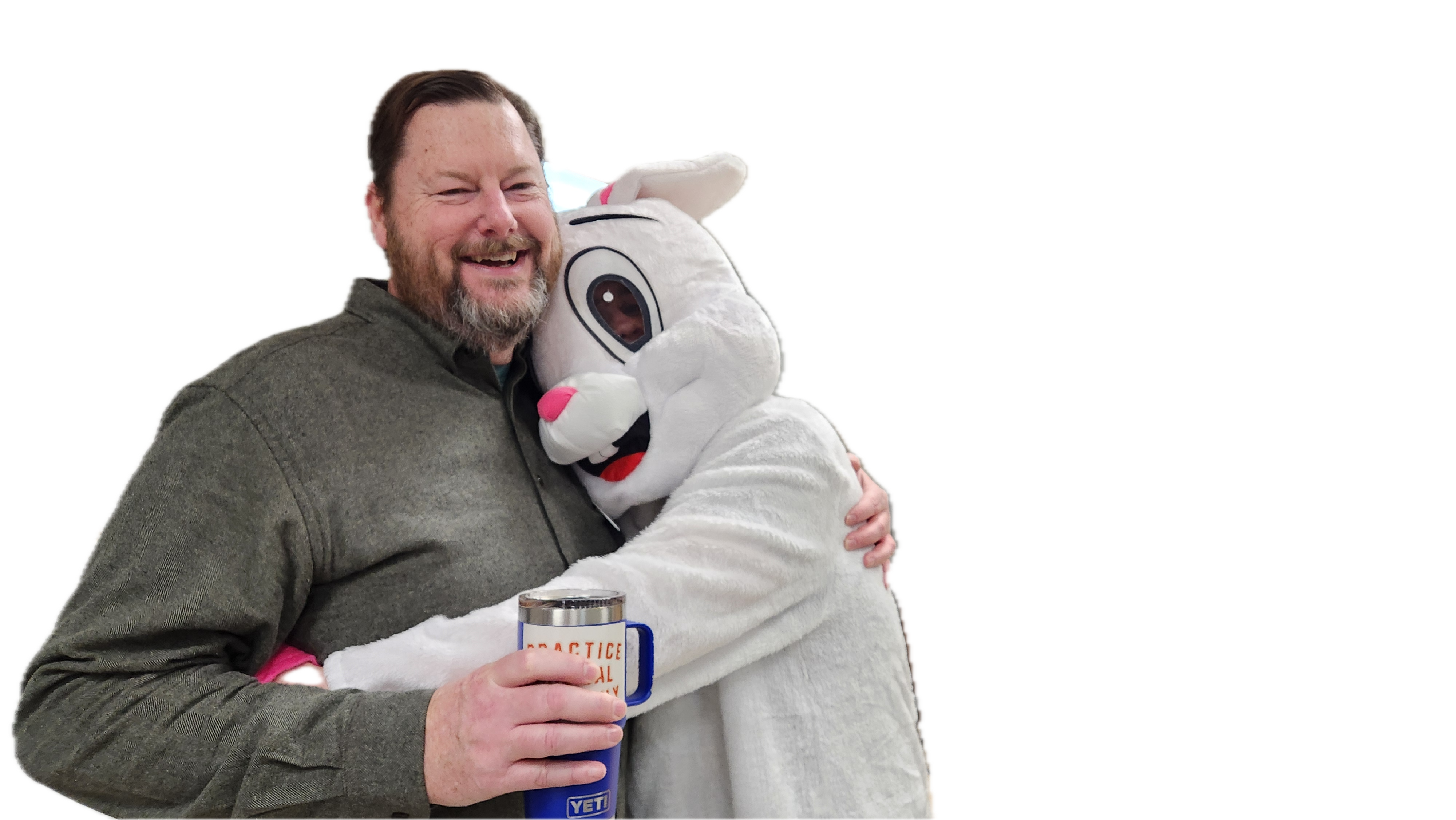
We kicked off our Holy Week activities with an Easter Egg hunt, featuring my favorite Easter Bunny. Linus (18) was at the end of his Spring Break, so he was able to don the bunny costume for the fourth consecutive year.
The next day was Palm/Passion Sunday, which began with a procession up Peyton Drive from Valley View Park. The three churches meeting on the Spring Valley campus walked and sang through our neighborhood, handing out palm branches to folks who peeked out their doors at the joyful noise! A couple of hours later, our music ministry shared their cantata; I have heard many positive, thankful comments- they did a fabulous job! If you haven’t had a chance to view it, click here: https://youtu.be/qKSpPS66lhg?si=Qr8GMJz68ZB2tu0D
Holy Week opportunities continue this week, with Holy Thursday and Good Friday, both in the Sanctuary at 7:00 p.m., and Easter Sunday: sunrise service back at Valley View Park, 7:00 a.m., and Sanctuary worship at 10:30 a.m. Stations of the Cross are also available throughout Holy Week in the Narthex.
The days leading up to, and including, Easter are the high points of the Christian year, and the reason the Church exists. As we wrap up the first quarter of the year, I am grateful for the new ministry partnerships that are being revealed around us. The financial generosity of the Spring Valley congregation is what makes our ministry possible. Thank you for your support! I am grateful for God’s grace, the divine love which was so powerful it raised Jesus from the dead and defeated the powers of darkness and evil forever. For a broken, hurting, war-torn world, the Easter Good News offers the possibility of renewal for the whole of creation.